Custom ERP development, built around your floor
An ERP that does not match how your business actually runs becomes a second job: the real work happens in WhatsApp and Excel, and someone keys it into the system afterwards. We build the other kind.
When the off-the-shelf system stops fitting
Most businesses do not outgrow their ERP. They outgrow the assumptions inside it. A packaged system is built for an average company in a category, and the places where you are not average are exactly the places where your margin comes from - the way you cost a job, the way you handle a return, the terms you give one customer and not another.
A custom ERP inverts that. The data model starts from your process: your job sheet, your batch, your lot, your approval chain. Nobody has to translate. The system can be strict about the things that must never be wrong, like stock balances and issue-receive weights, and relaxed about the things that genuinely vary from one order to the next.
That is a bigger commitment than buying a licence, and it is not always the right call. If a packaged platform covers eighty per cent of what you need and the rest is reporting, say so and we will tell you to buy it. Custom is worth it when the remaining twenty per cent is the business.
The floor first, the schema second
Every build starts on site, watching the work. What the paper form actually records. Which number is argued over at the end of the month. Who gets called when something does not reconcile. That is what determines the schema, and getting it wrong is expensive in a way no amount of front-end polish repairs.
We then build in slices that go live. A first release that handles one real workflow end to end beats a year of development against a specification, because the only honest feedback comes from someone using it on a Tuesday afternoon under pressure. Each slice ships with the exports your team already depends on, so nobody has to abandon their existing reporting to adopt the new system.
Stock, weights and money are modelled as an append-only ledger rather than a mutable balance. You can ask what the position was on any past date and get an answer that reconciles, which is the difference between a system you trust in an audit and one you quietly keep a spreadsheet alongside.
Boring technology, deliberately
Postgres for anything that must reconcile. Node or Django for the application layer. React or Angular on the front end, built to work on the devices your staff actually hold, which on a factory floor is usually an older Android phone with one bar of signal.
Decimal arithmetic for weights and money, never floating point - a rounding error in a gold issue-receive ledger is not a cosmetic bug. Background jobs for anything slow, so a month-end costing run does not block someone trying to raise a job card.
You get the repository. There is no runtime that only we can operate, no licence that expires, and no part of the system that cannot be handed to another team if you decide to take it in-house.
What ships with the build
- 01
Your workflow, not a template
The data model is derived from your process, including the parts that are unusual. Those parts are usually where the margin is.
- 02
Auditable by construction
An append-only ledger for stock, weights and money. Any past position can be reconstructed and reconciled.
- 03
Exports that match your paper
Reports that mirror the forms your team already uses, field for field, so adoption does not require retraining everyone at once.
- 04
Shipped in slices
One real workflow live early, then the next. You see working software in weeks, not a specification document.
- 05
You own the code
Full repository handover. No per-seat licence, no lock-in, no part of the system only we can run.
Questions we are actually asked
The first workflow is usually live in six to ten weeks, and that is deliberate - it is the only way to find out whether the data model is right while it is still cheap to change. A full replacement of a multi-department system is measured in quarters, not weeks, and we would rather tell you that at the start than halfway through.
A packaged ERP is cheaper in year one and the gap narrows every year after, because the licence recurs and the customisation work recurs with it. Custom is a larger upfront build with no per-seat cost afterwards. The honest decision point is how much of your process the packaged system would have to be bent to fit; if it is a lot, you will pay for that bending every year regardless.
Yes, and usually it should. Accounting is one of the few areas where the packaged tool is genuinely better, and your CA already knows it. We integrate rather than replace - the ERP owns operations, the accounting system stays the book of record, and the two reconcile on a schedule you can inspect.
You take the repository and the database and go. That is the point of owning the code. We write the system to be handed over, which mostly means documentation that explains why decisions were made rather than restating what the code already says.
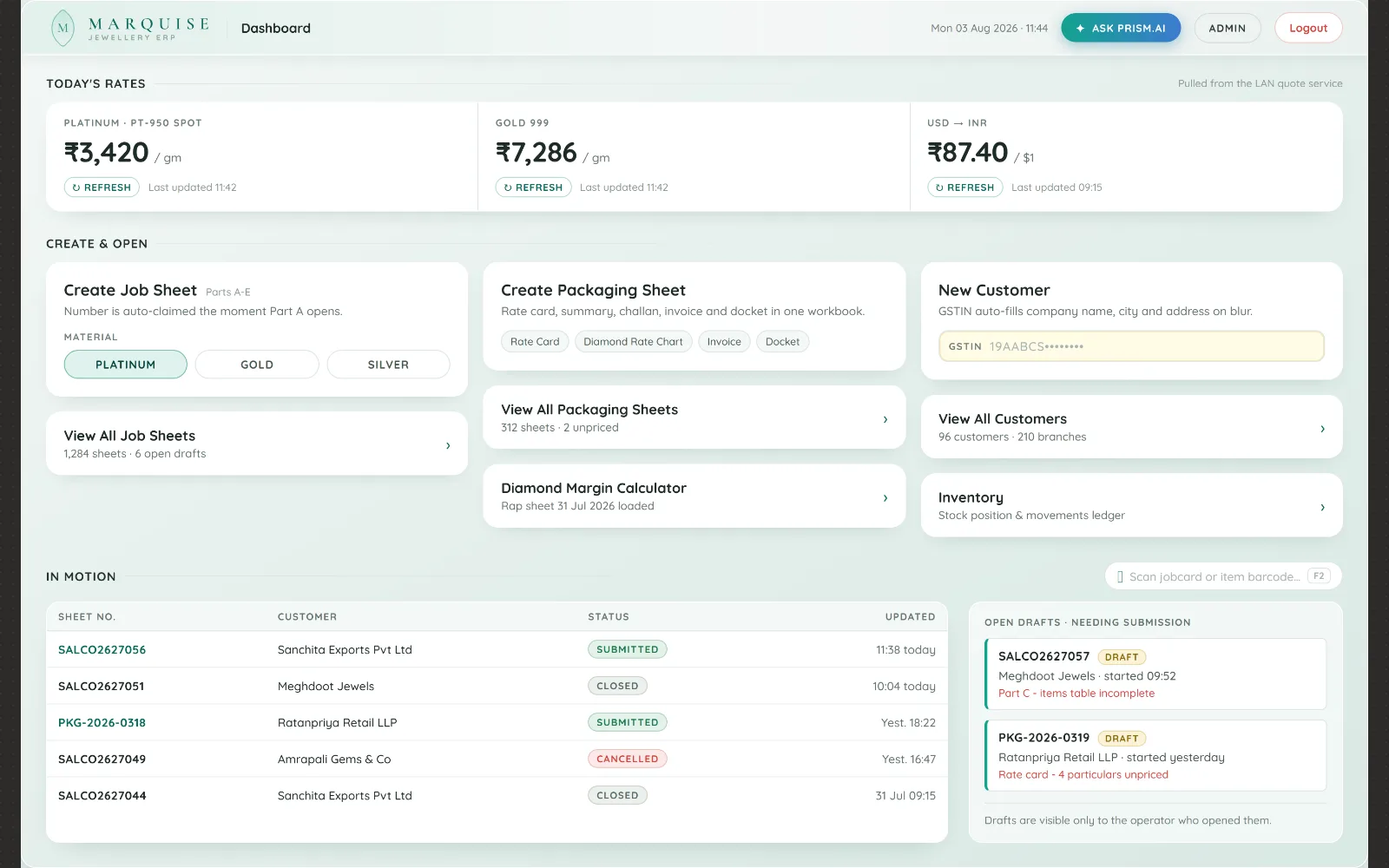
Yes. We are based in Ghatkopar East and a lot of the work is in and around Mumbai, but ERP builds involve enough on-site time at the start that we travel for them regardless. Marquise was built for a manufacturer in Kolkata.
Tell us what you are trying to build.
A short first conversation, no deck. If we are the wrong studio for it we will say so and point you somewhere better.