CRM software for real estate teams
Property sales are lost in the gap between an enquiry arriving and someone following it up. A CRM earns its place by closing that gap, not by producing another dashboard nobody opens.
The enquiry, the follow-up, the site visit
Leads arrive from portals, from campaigns, from hoardings and from channel partners, in different formats and at different times of day. They get assigned, or they do not. Someone calls, or they meant to. The deal is usually lost in the first few hours, long before anything that resembles negotiation.
So the system has to own that window: capture from every source into one queue, route by project and by availability rather than round-robin, and escalate when a lead goes untouched past an agreed threshold. The measure that matters is time to first contact, and it should be visible to the person responsible for it before it is visible in a monthly report.
Site visits are the next leak. Scheduled, confirmed, attended, followed up - each of those is a state with a different next action, and a CRM that records only a date is recording the least useful part of it.
WhatsApp, channel partners and inventory
Follow-up in Indian real estate happens on WhatsApp. A CRM that cannot see those conversations is recording a fiction, and asking a sales team to duplicate their messages into a web form is a request that will be ignored by week three. Integrating the channel properly - templates, delivery state, replies attached to the lead - is what makes the pipeline trustworthy.
Channel partners need their own view: their leads, their status, their brokerage, without seeing anyone else's. Getting that wrong is both a commercial problem and a trust problem, and it is a permissions question that belongs in the data model rather than in the interface.
Inventory - towers, floors, units, facings, availability and the hold that someone placed verbally this morning - has to be the same single source for the sales team, the channel partner and the booking desk. Two versions of availability is how a unit gets sold twice.
Bookings, payments and the compliance trail
After booking, the work becomes a schedule: demand letters tied to construction milestones, receipts, outstanding balances, and the reconciliation between what was collected and what the accounts show. This is where spreadsheets do the most damage, because an error here is a customer-facing error.
RERA brings documentation obligations with real deadlines attached. The system should produce that trail as a by-product of the work rather than requiring somebody to assemble it from three places each quarter.
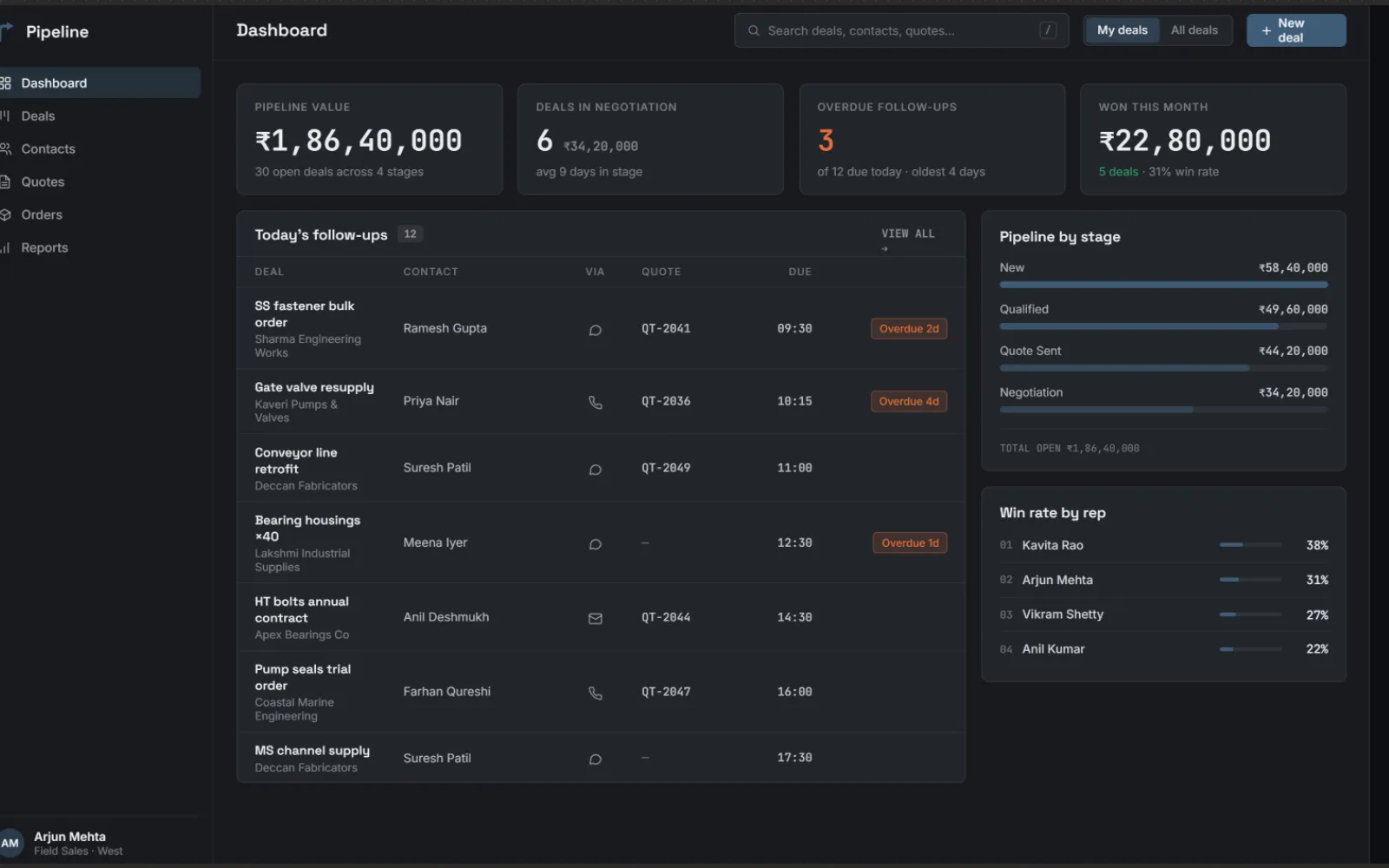
We have not shipped a real-estate build yet, and would rather say that than imply otherwise. What we have shipped is Pipeline - a B2B sales CRM with a shared deal pipeline, quote building, order conversion and WhatsApp follow-up - which is the same machinery pointed at a different inventory model.
What ships with the build
- 01
Every source into one queue
Portals, campaigns, walk-ins and channel partners captured together, routed by project and escalated when untouched.
- 02
WhatsApp that is actually integrated
Templates, delivery state and replies attached to the lead, so the pipeline reflects the conversation that really happened.
- 03
Channel partner portals
Their leads, their status, their brokerage - scoped in the data model rather than hidden in the interface.
- 04
One inventory, one truth
Towers, units, facings, holds and availability shared by sales, partners and the booking desk.
- 05
Payment schedules and RERA trail
Milestone-linked demand letters, receipts and reconciliation, with the compliance record produced as a by-product.
Questions we are actually asked
Not yet, and we would rather tell you that than imply otherwise. We have built Pipeline, a B2B sales CRM with a shared deal pipeline, quote building, order conversion and WhatsApp follow-up, which is the same machinery against a different inventory model. If you need a vendor with a shipped real-estate reference, that is a fair requirement and you should weigh it.
Yes, through the WhatsApp Business API with approved templates, delivery status and replies attached to the lead record. We have built this before on Pipeline. It matters more here than anywhere else, because a real-estate CRM that cannot see WhatsApp is recording a fiction.
For a straightforward brokerage, often you should, and we will say so. Custom earns its place when your inventory model, channel partner structure or payment schedules do not fit the packaged assumptions - which is common for developers and rare for pure brokerages.
Yes, with visibility scoped to their own leads, statuses and brokerage. The important part is that the scoping lives in the data model rather than in the interface, because a permissions bug here is a commercial and reputational problem, not just a display one.
It is built to produce the documentation trail as a by-product of the work - bookings, milestone-linked demand letters, receipts and reconciliation recorded as they happen. We are software engineers rather than compliance advisors, so your legal team confirms the obligations and we make sure the system can evidence them.
Tell us what you are trying to build.
A short first conversation, no deck. If we are the wrong studio for it we will say so and point you somewhere better.