Command bar
A keyboard-first Cmd+K entry point - the primary surface for office admins and merchandisers who live at a desk.
The intelligence layer inside Marquise, a jewellery manufacturing ERP. Prism answers questions about job sheets, weights, rates and compliance - in the language the floor actually speaks, and never with a number it cannot cite.
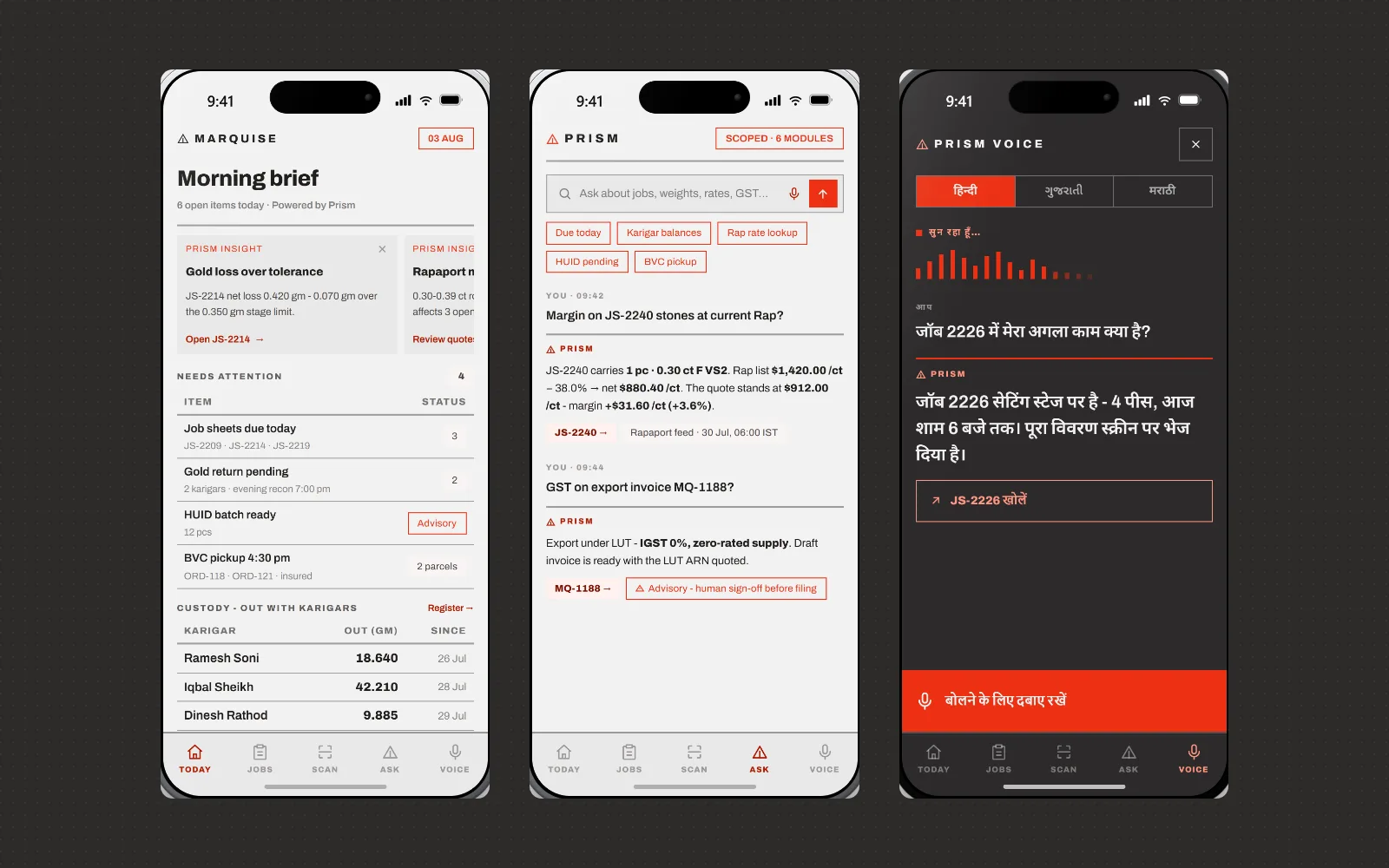
Marquise holds the records; Prism makes them answerable. Office staff reach it through a keyboard-first command bar, merchandisers through the job sheet they already have open, and karigars through a hands-free voice mode in Hindi, Gujarati or Marathi. Every answer is grounded in a record and links back to it - an assistant that refuses to guess is the only kind that belongs near a weight ledger.
A keyboard-first Cmd+K entry point - the primary surface for office admins and merchandisers who live at a desk.
Opened from a job sheet, Prism already knows the record. No re-stating which order you mean before you can ask about it.
A barcode or QR scan loads that entity straight into the assistant - built for hands that are already holding the piece.
Hands-free Hindi, Gujarati and Marathi for the factory floor, tuned for noise and capped at short spoken answers.
Dismissible insight chips on dashboards and a morning brief of what needs attention - pulled forward rather than searched for.
Weights, rates, purities and GST figures come from the database or the Rapaport feed. Missing data returns a stated gap, not an estimate.
function answer(q, rows) { if (rows.length === 0) { return gap(q) // state the gap - never estimate } return { text: compose(q, rows), cites: rows.map(r => r.href), // every figure links to its record }}const VOICE_WORD_CAP = 30function route(answer, surface) { if (surface !== 'voice') return toScreen(answer) return words(answer) <= VOICE_WORD_CAP ? toVoice(answer) : toScreen(summarise(answer)) // long answers are read, not spoken}Prism scopes strictly to six manufacturing modules - job sheets, karigar allotment, diamond pricing, gold custody, compliance and dispatch - and treats anything outside them as a redirect rather than an answer. Compliance output is always marked advisory, pending human sign-off.